ITIL 4 Foundation
Overview
ITIL is the most widely recognized best practice guidance framework for IT Service Management (ITSM). Originally standing for "Information Technology Infrastructure Library," ITIL no longer refers to that acronym and is kept as a mere brand name.
There is no specific governing body for ITIL; rather, it is maintained by several international organizations, including itSMF, Axelos, and PeopleCert.
Rather than a "law," ITIL is a set of recommendations that organizations adopt and adapt to:
- Plan & Implement new services.
- Support & Improve existing operations.
- Co-create value with stakeholders.
Core Concept: Value Co-Creation
The shift from "delivery" to "co-creation" is the biggest change in modern ITIL. The fundamental idea is that services drive value for both the service providers and the customers.
- The Service Provider: Offers the resources (servers, software, expertise).
- The Consumer/Customer: Provides the requirements and uses the service.
- The Outcome: Value is only realized when both sides interact effectively.
The Modern Shift: Integration with Agile, Lean, & DevOps
Due to constant change, a sense of urgency is needed to respond to modern business needs. Rapid evolution in the Service Management industry requires cross-functional collaboration. The new approach in ITIL is much more holistic, focusing on customer experience, value streams, and new ways of working.
ITIL 4 acts as the "glue" between these different methodologies:
- Agile: Provides the speed and iterative mindset.
- Lean: Focuses on removing "waste" (steps that don't add value).
- DevOps: Bridges the gap between development and operations through automation and cultural change.
- Cross-functional Collaboration: Ensures that the "Left hand knows what the right hand is doing" across the entire Service Value Chain.
Key Benefits & Business Outcomes
ITIL reflects changes trickling down from an evolving world, incorporating new, industry-proven best practices so that ITSM frameworks remain up-to-date.
By balancing Agility and Stability, organizations avoid the "move fast and break things" trap that leads to system outages. ITIL directly reflects business needs:
| Goal | ITIL's Contribution |
|---|---|
| New Revenue Streams | Standardized practices allow for faster deployment of new digital products. |
| Competitive Advantage | Efficiency in service delivery lowers costs, allowing for better pricing or higher margins. |
| Digital Transformation | Supports the shift from physical products to complex digital business models. |
The Four Dimensions of Service Management
To ensure a holistic approach, ITIL suggests looking at every service through these four lenses, which are useful for the effective and efficient facilitation of value for customers and other stakeholders.
Historically known as the "Four P's" (People, Process, Products, and Partners), the modern dimensions are:
- Organizations & People: Roles, responsibilities, and culture.
- Information & Technology: The data and tools required.
- Partners & Suppliers: Third-party vendors and contracts.
- Value Streams & Processes: The actual steps taken to create value.
External Factors (PESTLE)
Note: Every dimension is affected by multiple external factors.
- Political
- Economic
- Social
- Technological
- Legal
- Environmental
The Service Value System (SVS)
Along with the four dimensions of the service management, the Service Value System provides the central element of the ITIL framework. The SVS is the foundation on which the entire ITIL framework is built. It is a model representing how all the components of an organization work together to facilitate value creation.
At a high level, the flow is: Input -> SVS -> Outcome
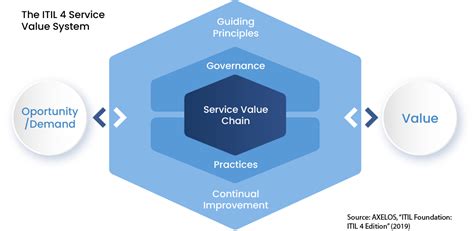
- Input: Opportunity / Demand
- Outcome: Value
The Triggers: Opportunity and Demand
As shown in the SVS diagram, every value-creating initiative is triggered by inputs. Part of the job in Service Management is to continuously find new ways to create or improve services by assessing these inputs and prioritizing which ones to fulfill.
- Opportunity: Options or possibilities to add value for stakeholders or otherwise improve the organization. These are potential avenues for value creation, even if there isn't active demand for them yet.
- Demand: The actual need or desire for products and services from internal and external customers. Demand acts as the direct input into the SVS.
Together, these inputs feed into the system to generate its ultimate outcome: Value.
Components of SVS
- ITIL Service Value Chain (SVC): An operating model for service providers that covers all key activities required to effectively manage products and services.
- ITIL Guiding Principles: Recommendations that can guide an organization in all circumstances, regardless of changes in its goals, strategies, type of work, or management structure.
- Governance: The means by which an organization is directed and controlled.
- ITIL Practices: Sets of organizational resources designed for performing work or accomplishing an objective.
- Continual Improvement: The practice of aligning an organization's practices and services with changing business needs through the ongoing identification and improvement of all elements involved in the effective management of products and services.